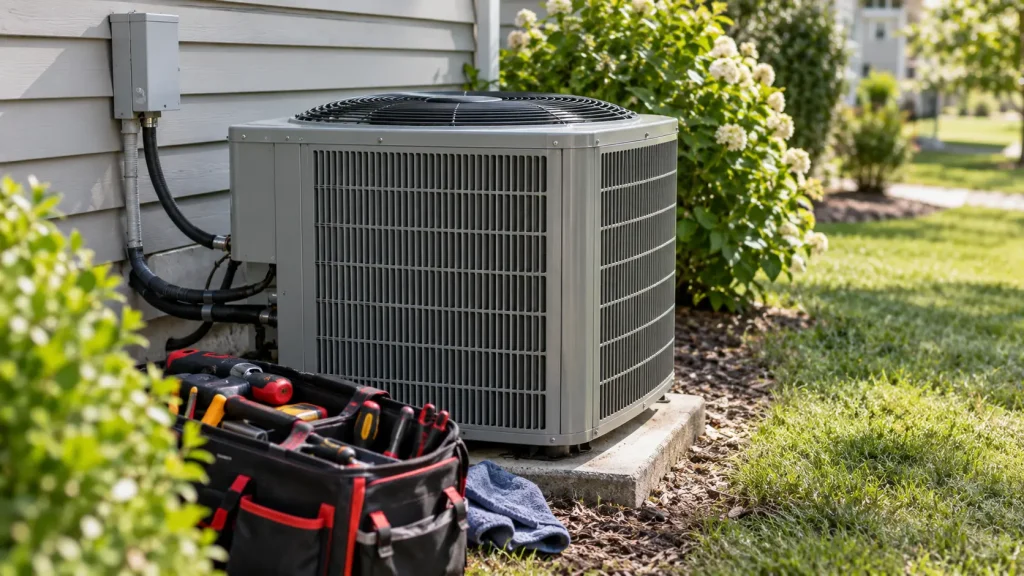
You can hear the air conditioner running. Air is coming from the vents. But the house is still warm.
That combination is frustrating because the system appears to be working — just not doing the one thing you need it to do.
An AC that runs without cooling properly can have a surprisingly simple cause, such as an incorrect thermostat setting or a clogged filter. It can also point to a frozen coil, an outdoor-unit problem, restricted airflow or a refrigerant issue.
Before assuming the worst, start with the checks that don’t require opening electrical panels or touching the refrigerant system.
First: Do These 5 Quick Checks
Before calling for service, check:
- Is the thermostat set to COOL?
- Is the set temperature below the current room temperature?
- Is the air filter visibly dirty?
- Are the supply and return vents open and unobstructed?
- Is the outdoor unit running and clear of obvious debris?
If one of those explains the problem, you may have found a relatively simple fix.
If everything looks normal, work through the possibilities below.
1. The Thermostat Setting Is Wrong
Start with the easiest possibility.
Make sure the thermostat is set to COOL, not simply FAN.
When the thermostat is set to FAN, the blower can circulate indoor air even though the air conditioner isn’t actively cooling it. That makes it sound as though the AC is operating normally.
Set the thermostat several degrees below the current indoor temperature and give the system a little time.
If you use a programmable or smart thermostat, also check the schedule. An unexpected temperature setting may have been triggered automatically.
Battery-powered thermostats are worth checking as well if the display looks weak or behaves unusually.
If the system responds normally after correcting the thermostat, you may not have an AC problem at all.
2. The Air Filter Is Clogged
A dirty filter is one of the first things worth checking when cooling performance drops.
Your air conditioner needs a steady flow of indoor air across the system. As a filter fills with dust and debris, airflow can become restricted.
The result can be:
- weaker airflow from the vents
- longer cooling cycles
- higher energy use
- reduced comfort
- additional stress on the equipment
ENERGY STAR recommends inspecting filters regularly and cleaning or replacing them when dirty. During periods of heavy heating or cooling use, checking about once a month is a useful habit.
Remove the filter according to the manufacturer’s instructions and hold it up to the light.
If it is heavily coated with dust, replace it with the correct type and size.
Don’t automatically buy the most restrictive filter you can find. Your HVAC system needs a filter compatible with its airflow requirements.
3. Something Is Restricting Airflow Inside the House
The filter isn’t the only place airflow can be restricted.
Walk through the house and look at the supply vents.
Are they open?
Has furniture been pushed over one?
Is a rug covering a floor register?
Then locate the return-air grilles. Large return vents are particularly important because the system needs to pull indoor air back into the HVAC equipment.
Blocking returns can interfere with that process.
If only one or two rooms are warm while the rest of the house cools normally, the problem may be more localized.
Possible causes include:
- closed registers
- damaged or disconnected ductwork
- duct leakage
- poor balancing
- inadequate insulation
- excessive heat entering the room
If airflow feels weak throughout the entire house even with a clean filter and open vents, the problem may require professional diagnosis.
4. The Outdoor Unit Can’t Release Heat Properly
Your indoor and outdoor equipment work together.
The outdoor condenser needs airflow around it so the system can release heat collected from inside the house.
Go outside and look at the unit.
You don’t need to open anything.
Check whether:
- the fan appears to be running
- leaves or grass are packed around the unit
- vegetation has grown against it
- objects are blocking airflow
- the coil looks heavily covered with dirt or debris
Keep the surrounding area reasonably clear.
ENERGY STAR specifically recommends keeping indoor and outdoor HVAC equipment clear of leaves, dirt and other debris. Dirty condenser and evaporator coils can reduce cooling ability and make the system run longer.
Avoid dismantling the outdoor unit or poking tools through the grille.
If the indoor blower is running but the outdoor unit isn’t operating, that is a good reason to stop troubleshooting and contact a qualified HVAC technician.
5. The Evaporator Coil May Be Frozen
Ice and air conditioning don’t always mean “extra cold.”
Ice on the indoor coil can actually prevent the system from cooling your house.
As ice builds, it restricts airflow and interferes with normal heat transfer.
You may notice:
- weak airflow
- little cooling
- ice on accessible refrigerant tubing
- water around the indoor unit after the ice begins melting
- unusually long operating cycles
A frozen coil is a symptom, not the underlying diagnosis.
Restricted airflow can contribute to freezing, but refrigerant or equipment problems can also be involved.
If you see ice, don’t keep forcing the AC to run in cooling mode.
Turn cooling off and allow the system to thaw. You can check obvious airflow issues such as a dirty filter or blocked vents.
If the coil freezes again after those issues are corrected, arrange professional service.
Repeatedly thawing it without fixing the cause isn’t a repair.
6. The Condensate Drain May Be Blocked
Air conditioners don’t just cool air; they also remove moisture.
That moisture has to drain away.
The condensate system normally carries water from the indoor equipment to an appropriate drain location.
If that drain becomes clogged, some systems may shut down or interrupt cooling to prevent water damage.
Signs can include:
- water around the indoor unit
- a full drain pan
- unusually high indoor humidity
- water stains near HVAC equipment
- a system that stops unexpectedly
ENERGY STAR includes inspection of the condensate drain as part of normal HVAC maintenance because a blocked drain can contribute to water damage and humidity problems.
If you can safely see an obvious drain problem without opening the equipment, note it.
For inaccessible drains, repeated blockages or significant water leakage, professional service is the safer option.
7. The Refrigerant System Has a Problem
Refrigerant is part of the closed system that allows your AC to move heat from inside your home to the outdoors.
It isn’t something an air conditioner should simply “use up” during normal operation.
If refrigerant charge is incorrect or refrigerant has leaked, cooling capacity can drop.
Possible symptoms can overlap with many other AC problems:
- the system runs for long periods
- the house doesn’t reach the thermostat setting
- cooling becomes progressively worse
- the indoor coil freezes
- the temperature difference between return and supply air seems abnormal
This is where DIY troubleshooting should stop.
Don’t try to solve a suspected refrigerant problem by purchasing a can and “topping off” the system.
Proper diagnosis requires measurements, and refrigerant work is subject to safety and regulatory requirements. ENERGY STAR includes checking and correcting refrigerant level among tasks for a qualified cooling-system service visit.
A technician should determine why the refrigerant condition is wrong rather than simply adding more.
8. The AC May Be Running Normally but Unable to Keep Up
Sometimes the equipment is operating, but the house is gaining heat faster than the system can remove it.
This can become noticeable during unusually hot weather.
But weather isn’t the only possibility.
Cooling demand can increase because of:
- air leaks
- poor attic insulation
- unshaded windows receiving strong afternoon sun
- duct leakage
- home additions
- changes to the building
- an incorrectly sized system
This is why replacing the air conditioner isn’t always the first answer.
ENERGY STAR notes that air leakage and duct problems can sometimes be the real source of comfort problems rather than the HVAC equipment itself.
If the AC cools normally on moderate days but struggles only during extreme heat, that pattern is useful information for a technician.
If it used to cool the house easily under similar conditions and suddenly cannot, a system problem becomes more likely.
What You Can Safely Check Yourself
A homeowner can usually perform basic observations without opening equipment:
| Check | DIY? |
|---|---|
| Thermostat mode and temperature | Yes |
| Air filter condition | Yes |
| Open/blocked room vents | Yes |
| Blocked return grilles | Yes |
| Debris around outdoor unit | Yes |
| Visible ice | Observe only |
| Water around indoor equipment | Observe / basic accessible checks |
| Electrical components | No |
| Refrigerant pressure or charge | No |
| Compressor diagnosis | No |
| Internal motor/capacitor testing | No |
The dividing line is simple:
Checking is different from dismantling.
You can look at a filter.
You don’t need to remove an electrical panel to test components.
You can notice ice on a visible line.
You don’t need to connect gauges to the refrigerant system.
When Should You Call an HVAC Technician?
Professional diagnosis makes sense when:
- the outdoor unit doesn’t run
- breakers repeatedly trip
- you smell burning or see damaged wiring
- the coil repeatedly freezes
- cooling remains poor after replacing a dirty filter
- airflow is weak throughout the house
- there is significant water leakage
- you suspect a refrigerant problem
- the system makes new grinding, buzzing or other abnormal sounds
- the AC runs continuously but the indoor temperature keeps rising
Electrical and refrigerant problems aren’t good trial-and-error DIY projects.
A qualified technician can measure things that aren’t visible during a basic homeowner inspection, including refrigerant conditions, electrical performance and blower operation.
Don’t Ignore an AC That Runs Constantly
An air conditioner that never seems to stop is doing more than making the house uncomfortable.
Long operating cycles can also increase electricity use and put additional wear on the equipment.
Dirty coils, restricted airflow and incorrect refrigerant conditions can all reduce cooling performance. ENERGY STAR notes that airflow problems can significantly reduce system efficiency, while dirty coils make equipment run longer.
So if the system has clearly changed from how it normally operates, don’t assume that running continuously is harmless.
Find the cause.
Start Simple Before Assuming the AC Is Failing
When an AC runs but doesn’t cool, it’s easy to jump immediately to an expensive conclusion.
Don’t.
Start with the thermostat.
Check the filter.
Make sure the vents aren’t blocked.
Look at the outdoor unit.
Check for visible ice or water.
Those few observations can either uncover a simple problem or give an HVAC technician much better information when you call.
If those basics look normal and the house still isn’t cooling, the issue is probably beyond ordinary homeowner troubleshooting.
At that point, the goal isn’t to keep replacing random parts.
It’s to get the system properly diagnosed.