The washing cycle sounds normal. Then the spin cycle starts, and the machine begins thumping against the cabinet or moving across the floor.
Before assuming an expensive part has failed, check the laundry and the installation. An uneven load, unstable feet or shipping bolts left in a newly installed front-loader can all cause excessive shaking. These are among the first things manufacturers recommend checking.
A little vibration during spinning is expected. A washer that repeatedly bangs, jumps or “walks” out of position needs attention.
The most useful starting point is figuring out when the shaking happens.
What the Timing Can Tell You
Does the problem happen with one particular blanket, or with almost everything you wash? Did it start after the machine was moved?
Use this table to decide where to begin:
| When the shaking happens | Check first |
|---|---|
| Only with bedding, towels or a single heavy item | Load balance and the selected cycle |
| From the first use after installation | Shipping restraints, leveling and floor support |
| After moving the washer to a different position | Foot contact, leveling and nearby objects |
| With different, normally sized loads | Installation first; service if the problem persists |
These are troubleshooting starting points, not diagnoses. Manufacturers identify both loading and installation problems as common causes of vibration, so the pattern helps narrow the investigation.
Before inspecting the machine: pause the cycle and wait for the drum to stop completely. Never force open a locked door or try to hold a moving washer in place. Switch off and unplug the machine before making physical adjustments, provided the plug is safely accessible and the area is dry. If moving or accessing it would be unsafe, leave that work to an installer or technician.
Start With the Laundry, Not the Toolbox
One heavy, absorbent item can throw a load off balance. A bathmat or blanket may gather on one side of the drum, making the washer struggle as it accelerates.
Once the machine has stopped and the door unlocks normally, untangle the contents and redistribute them. If the drum is tightly packed, remove some items rather than forcing everything back inside.
A small load is not automatically a balanced load. Washing one heavy item alone can cause problems even when the machine is nowhere near its maximum capacity. Samsung specifically warns about this situation in its vibration guidance.
For bedding or other bulky items, check both the care label and your washer’s manual. Some items require a particular cycle or a larger machine. Add balancing items only when the instructions allow it and there is still sufficient capacity. Do not solve an imbalance by overloading the drum.
After correcting the load, resume according to the manual. If severe banging returns, stop again rather than repeatedly forcing the machine through the spin cycle.
Is the Washer New or Recently Moved?
A front-loading washer normally arrives with transport restraints that hold its suspended tub in place during delivery. These must be removed as directed before operation.
If shipping bolts remain installed, the machine can vibrate severely. LG warns that operating a front-loader with those restraints in place can cause damage.
Check the installation instructions for your exact model. Do not remove random bolts from the back of the washer. The manual should identify the transport fittings and explain which pieces must come out.
Other washer designs can use different shipping materials. For example, some GE top-loaders use a shipping rod rather than the familiar rear bolts found on front-load machines.
If a newly delivered washer shakes violently during its first cycle, contact the installer before running another load.
Check Whether the Machine Is Stable
A washer can look straight while still having one foot that does not firmly touch the floor.
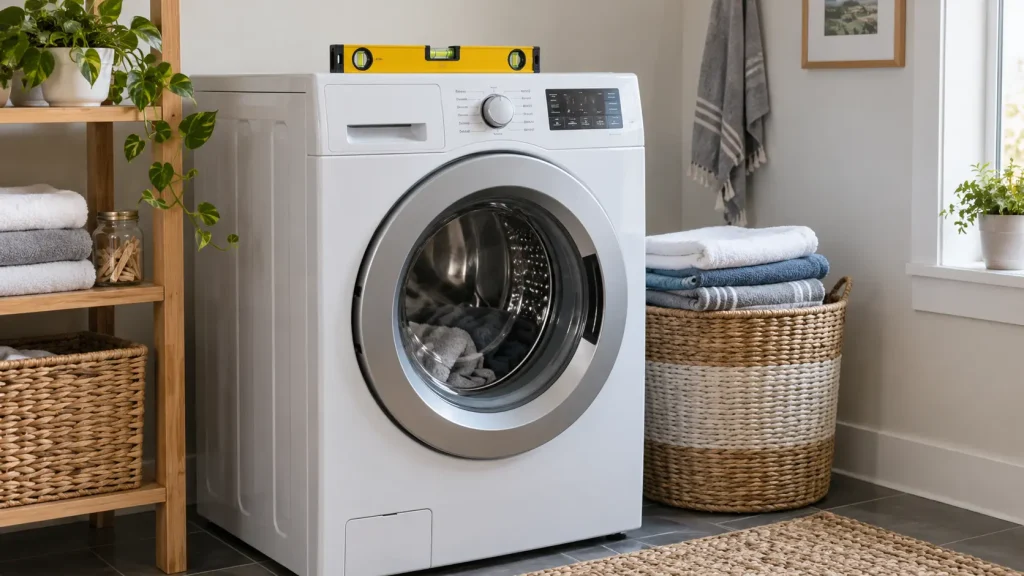
With the machine off, gently check for rocking at opposite corners. Use a spirit level across the top, checking both side to side and front to back.
The goal is not just a centered bubble. The washer must also stand firmly on all its supporting feet.
If adjustment is needed, follow the installation manual. Many models have locking nuts that must be tightened after leveling so the feet stay in position. A washer mounted on a pedestal also depends on the pedestal being correctly attached and stable. Whirlpool highlights all of these checks in its installation guidance.
Do not tip a heavy washer onto yourself, reach underneath an unsupported appliance or move a stacked laundry pair alone. An installer can handle adjustments that are not safely accessible.
The Floor Can Be Part of the Problem
A level washer still needs a sufficiently rigid floor.
If the floor flexes during spinning, vibration may travel beyond the laundry area. Whirlpool notes that vibration felt across the room can indicate floor flexing and recommends checking the installation’s flooring requirements.
This is worth investigating when the problem began after relocating a previously stable machine.
Do not assume a thick rubber mat will fix it. An accessory cannot remove shipping restraints or repair an unsuitable installation. Before buying pads, stands or platforms, check whether the manufacturer permits them for your model.
If the flooring visibly sags or the support is uncertain, have the installation assessed rather than improvising a base.
Make Sure Nothing Is Touching the Washer
Not every loud sound comes from inside the machine.
Check whether the cabinet touches a wall, dryer, shelf or neighboring cupboard. Remove objects resting against it and check for loose items around the laundry area.
Samsung recommends keeping the washer from contacting surrounding objects as part of its noise troubleshooting.
Use your model’s installation instructions for clearance requirements. There is no single gap that suits every freestanding, built-in or stacked arrangement.
This check is especially useful for a rattle or tapping sound. It is less likely to explain violent movement of the entire appliance.
Why Does the Washer Keep Pausing Before It Spins?
Repeated pauses do not necessarily mean the motor has failed.
Some washers detect an uneven load and attempt to redistribute it before reaching full spin speed. Depending on the model, that can involve extra movement, added water, a longer cycle or an imbalance message.
If the machine cannot correct the load, spinning may be reduced or stopped, leaving clothes wetter than expected. Whirlpool describes these behaviors in its out-of-balance troubleshooting guidance.
Read any displayed code in your model’s manual rather than treating every pause as a mechanical failure.
However, there is a difference between a controlled balancing attempt and a washer repeatedly striking its surroundings. Severe movement is a reason to stop and investigate, not simply wait for the program to finish.
Does the Washer Need Calibration?
Some models have a calibration procedure associated with installation or load sensing. Samsung, for example, provides calibration instructions for supported machines, but the controls differ by model.
Check your manual before trying a button combination from a video.
Calibration is not a substitute for a stable installation. Establish that the transport fittings have been removed, the feet are secure and the machine is correctly loaded before following any model-specific calibration instructions.
A generic “reset” should not become the answer to every vibration problem.
When the Problem Needs a Technician
If the washer continues shaking badly with different, appropriate loads after installation checks, arrange service.
Internal components can wear. Whirlpool identifies worn shock absorbers or drum bearings as possible sources of imbalance, but shaking alone does not tell you which part—if any—needs replacement.
Stop using the washer and seek assistance if there is persistent grinding, severe banging or visible damage. Burning smells, smoke or water near electrical connections require particular caution; do not reach through water to unplug the appliance.
Avoid ordering suspension parts or bearings based only on a similar-sounding online video. A technician should establish the cause before replacing components.
What to Record Before Booking a Repair
A short description of the pattern can make a service request more useful than simply saying, “The washer is noisy.”
Note the model number, any error code, what was in the load and whether the problem began after installation or a move. Explain whether it happens with every load or only with bulky items.
A brief recording from a safe distance may help, particularly when the noise is intermittent. Do not restart a violently shaking machine just to capture a video.
The first distinction to make is straightforward: a problem that follows a particular load calls for a loading check; a problem that persists across loads calls for a closer look at the installation and machine. Start with those observations before spending money on parts.